Mada za sehemu hiiVectorsMada 5
- Displacement and position vectors
- Magnitude and direction of vector
- Sum and difference of vectors
- Multiplication of a vector by a scalar
- Application of vectors
Definition: The magnitude (or modulus) of a vector is the size of a vector. It is a scalar quantity that expresses the size of a vector regardless of its direction.
Finding the magnitude of a given vector: Normally the magnitude of a given vector is calculated by using the distance formula which is based on Pythagoras theorem.
Using Pythagoras Theorem
Let be the position vector on the -plane.

From the figure above,
Since and .
So
Now if , then its magnitude is denoted by which is given by
The direction of a vector may be given by using either bearings or direction cosines.
(a) By Bearings
Bearings are angles from a fixed direction in order to locate the interested places on the earth's surface.
Reading bearings: There are two methods used to read bearings. In the first method all angles are measured with reference from the North direction only whereby the North is taken as 000°, the East is 090°, the South is 180° and West is 270°.
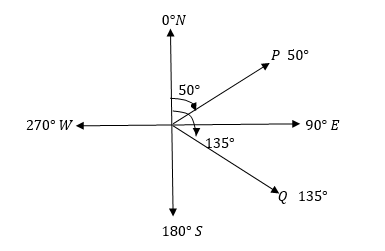
From the figure above, point P is located at a bearing of 050°, while Q is located at a bearing of 135°.
Commonly, the bearing of point B from point A is measured from the north direction at point A to the line joining AB, and that of A from B is measured from the north direction at point B to the line joining BA.
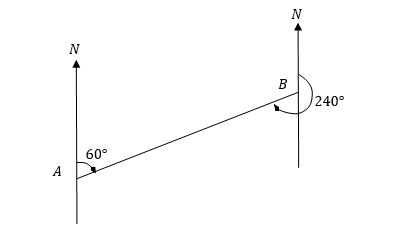
From the figure above, the bearing of B from A is 060° while that of A from B is 240°.
In the second method, two directions are used as reference directions: these are North and South.
In this method, the location of places is found by reading an acute angle from the north eastwards or westwards and from the south eastwards or westwards.
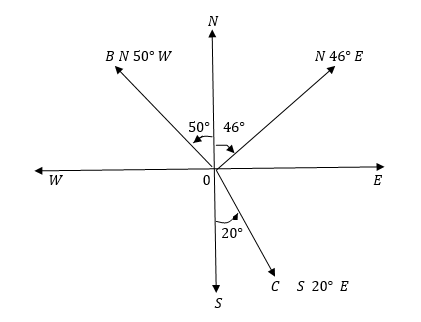
From the figure above, the direction of point A from O is N46°E, that of B is N50°W, while the direction of C is S20°E.
Mikumi is 140 km at a bearing of 070° from Iringa. Makambako is 160 km at a bearing of 215° from Iringa. Sketch the position of these towns relative to each other, hence calculate the magnitude and direction of the displacement from Makambako to Mikumi.
Solution
Let (1 cm) represent (20 km), and let (AB) be the displacement from Makambako to Mikumi. The following sketch describes the location of these two places relative to each other. Since (AB) is the displacement from Makambako to Mikumi, then the distance between (A) and (B) is the distance between the two places. This is to say point (A) stands for Makambako and (B) for Mikumi.
Sketch
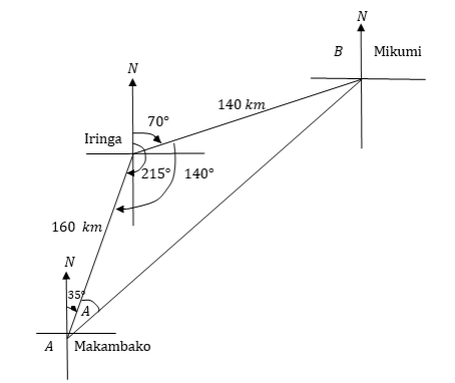
Using the cosine rule:
The displacement from Makambako to Mikumi is approximately 286 km.
By sine rule:
The bearing of Mikumi from Makambako is or N51.3°W.
Alternatively, by using the scale AB is approximately 14.3 cm. Therefore AB = 14.3 × 20 km = 286 km and the bearing is obtained by protractor which is about N51°E.
(b) Direction Cosines
Where and are the direction cosines of OP.
Definition: If makes angles and with the positive directions of x and y axes respectively, then the cosines of and are the direction cosines of the vector .

From the figure above, and , also
Therefore:
Mwalimu
Unasoma somo hili? Niulize nikuelezee chochote kilichomo.
Ingia ili kumuuliza Mwalimu wa AI wa Sonza kuhusu mada hii.
Ingia ili kuulizaMajadiliano
Hakuna maswali bado