Mada za sehemu hiiStructure Of The EarthMada 3
- The Earth’s Crust, The Mantle, The Core and their Respective Characteristics
- Types of Rocks of the Earth’s Crust
- Simplified Geological Time Scale
The inner zones of the earth constitute the internal structure of the earth. The internal structure of the earth consists of three zones:
- Crust / Lithosphere
- Mantle / Mesosphere
- Core / Barysphere

Crust
-
The outermost and thinnest zone of the earth, found between 8–50 km (or 5–30 miles).
-
Also known as the Lithosphere.
-
Largely composed of igneous rocks (crystalline, hard, and brittle).
-
Consists of two layers:
- Sial:
- Outer layer of the crust.
- Rich in silica and aluminum minerals.
- Forms the basis of the continent.
- Sima:
- Found beneath the sial layer.
- Separated from sial by the Conrad discontinuity line.
- Composed of silica and magnesium.
- Sial:
Mantle
-
Also known as the Mesosphere.
-
Found between the crust and the core.
-
Separated from the crust by the Mohorovic discontinuity (Moho).
-
Extends downward to about 2900 km (1800 miles).
-
Temperatures may reach about 5000°C.
-
Consists of two parts:
- Upper Mantle:
- Rigid and together with the crust forms the lithosphere.
- Lower Mantle:
- Less rigid.
- Forms the asthenosphere (molten layer within the Earth's interior).
- Upper Mantle:
Core
-
The innermost zone of the Earth's structure.
-
Also known as the Barysphere or Centrosphere.
-
Diameter of about 6900 km (4300 miles).
-
High density.
-
Divided into two parts, separated from the mantle by the Gutenberg discontinuity:
- Outer Core:
- Liquid in nature due to high temperature (up to 3700°C).
- Composed of nickel and iron (NIFE).
- Thickness of about 2100 km.
- Density of about 10.5 g/cm³.
- Inner Core:
- Solid due to extremely high pressure.
- Composed mainly of iron.
- Diameter of about 2600–2700 km (1600–1700 miles).
- Outer Core:
Consists of four main layers:
- Atmosphere
- Hydrosphere
- Lithosphere (Landmass)
- Biosphere
Atmosphere
-
A thin layer of gases held around the earth by gravitational attraction.
-
Composed of:
- Abiotic components (non-living matter):
- Mixture of gases (Nitrogen, Oxygen, Argon, Carbon dioxide).
- Water vapor.
- Dust particles.
- Biotic components (living organisms):
- Microscopic organisms like bacteria.
- Abiotic components (non-living matter):
Composition of the atmosphere
- Mixture of gases:
- Nitrogen (78%)
- Oxygen (21%)
- Argon (0.009%)
- Carbon dioxide (0.03%)
- Water vapor:
- Colorless, odorless, and forms a perfect mixture with gases.
- Biota components:
- Includes microscopic organisms like bacteria.
Structure of the atmosphere
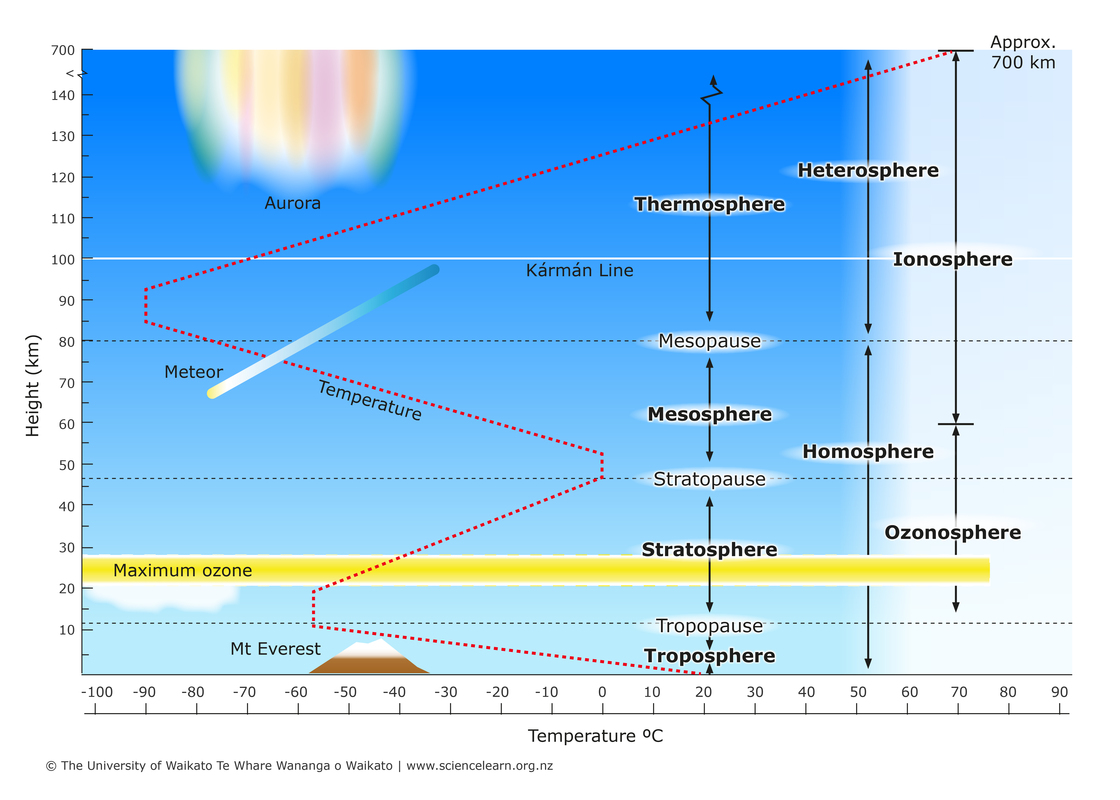
Divided into two zones based on temperature changes:
- Homosphere
- Heterosphere
Homosphere (0–80 km above sea level)
-
Composed of uniform gases and temperature.
-
Divided into three layers:
- Troposphere:
- Extends from 0–15 km.
- Nearest to Earth.
- Contains water vapor, gases, and dust.
- Supports life (plenty of oxygen).
- Stratosphere:
- Extends from 15–48 km.
- Lies above the tropopause.
- Contains water vapor, dust particles, and gases.
- High concentration of ozone gas.
- Mesosphere:
- Extends from 48–80 km.
- Temperature decreases with altitude.
- Separated from stratosphere by stratopause.
- Upper boundary is called mesopause.
- Troposphere:
Heterosphere (Above 80 km towards space)
-
Extends into interplanetary space.
-
Divided into two layers:
- Thermosphere:
- Temperature increases with altitude.
- Lacks water vapor and dust.
- Contains ions (affect radio communication).
- Exosphere:
- Found above the thermosphere.
- Very high temperatures but little research conducted.
- Thermosphere:
- Insulation:
- Acts as an insulator or shield, regulating temperature during the night and winter.
- Solar Filtering:
- Filters solar radiation.
- Prevents harmful ultraviolet (UV) rays of certain wavelengths from reaching the Earth's surface due to the ozone layer in the stratosphere.
- Scientific Function:
- Acts as a medium for scientific experiments and observations.
- Example: The ionosphere reflects some electromagnetic waves and radio signals back to Earth.
- Support for the Hydrological Cycle:
- Facilitates processes such as surface water evaporation, condensation, and precipitation formation.
- Support for Life:
- Provides essential gases like oxygen necessary for living organisms.
- Atmospheric pressure, due to the weight of air, enables breathing.
- Variations in atmospheric pressure cause wind movement and influence temperature, humidity, and precipitation.
- Refers to the layer consisting of all water bodies on Earth.
- Includes oceans, rivers, precipitation, and underground water.
- Covers approximately 75% of the Earth's surface.
- The solid part of the Earth.
- Includes various landforms such as mountains, valleys, and plateaus.
- Also known as the crust.
- Composed of:
- Continents (major land masses)
- Islands (minor land masses)
- A complex zone that includes all living things.
- Encompasses parts of:
- The lower atmosphere,
- The upper lithosphere,
- And the upper hydrosphere.
- Receives energy from the sun, providing conditions necessary for life.
- Unique to Earth, not found elsewhere in the solar system.
- Composed of elements, minerals, and rocks.
- These materials vary in physical and chemical properties.
Elements
- Smallest particles of matter that cannot be split into other forms.
- Examples include:
- Magnesium
- Potassium
- Sodium
- Iron
- Aluminum
- Silicon
Minerals
- Naturally occurring substances.
- Have definite shape, color, and resistance.
- Formed through the combination of different elements.
Mwalimu
Unasoma somo hili? Niulize nikuelezee chochote kilichomo.
Ingia ili kumuuliza Mwalimu wa AI wa Sonza kuhusu mada hii.
Ingia ili kuulizaMajadiliano
Hakuna maswali bado